F1 just retired DRS after fifteen seasons and replaced it with a fully active aero system — wings that reshape themselves every lap depending on whether the car is cornering or on a straight. Techgeeks built a version of "active downforce" into our line follower robots, just using suction instead of wings. Here's the physics behind both, and why it's the real reason our Suction Chassis robots hold corners other robots can't.
LEARN PHYSICS
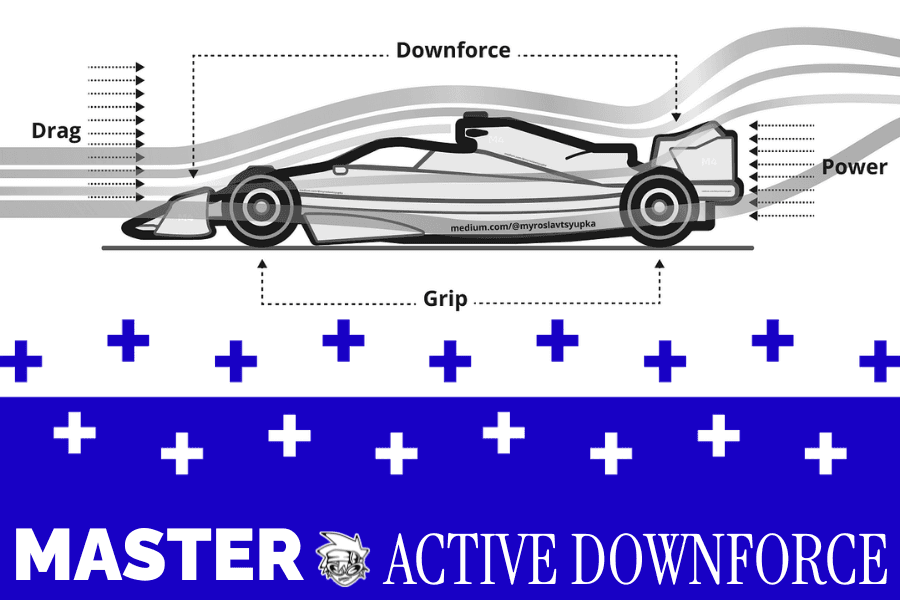
In 2026, Formula 1 said goodbye to the Drag Reduction System (DRS) it had used for fifteen straight seasons and replaced it with something more ambitious: active aerodynamics, where the front and rear wings physically change shape lap after lap depending on whether the car is cornering or flat-out on a straight. It's one of the biggest engineering shifts the sport has made in over a decade.
It's also a good entry point into a question worth understanding properly if you build competition robots: what does "downforce" actually mean, and why does an impeller-driven suction chassis let a line follower corner at speeds a normal chassis simply can't hold? Different vehicle, same underlying physics. This post breaks down what active downforce really is, how F1's new wings use it, and how a much smaller machine applies the same core principle in a completely different way.
Downforce Is a Pressure Trick, Not a Weight Trick
Most people's first guess at "more grip" is "more weight." It feels intuitive — heavier things stick to surfaces better. It's also the wrong answer for a race vehicle.
Adding mass does increase friction slightly, but it also adds inertia. A heavier car or robot needs more force to turn, more force to stop, and more force to accelerate. You gain a little grip and lose speed everywhere else.
Downforce solves the same problem without the trade-off. It uses moving air to create a pressure difference that presses a vehicle into the track — without adding a single gram of mass. More grip, same weight, same acceleration. That's the entire appeal, in both motorsport and robotics.
Think of it this way: if you wanted to double a robot's grip by adding weight, you'd have to double its mass — and now the motors are dragging twice the robot around the track. Generate the same grip with downforce, and the robot never notices the difference in a straight line. It only shows up exactly where you want it: mid-corner.
Two Ways to Generate It: Push From Above, Pull From Below
F1 cars generate downforce two different ways. Wings push down — angled surfaces deflect air upward, and by Newton's third law, the car gets pushed down in return. It's the same principle as an upside-down airplane wing.
The floor works the opposite way. Modern F1 cars use shaped underbody tunnels (this is what people mean by "ground effect") that accelerate air as it passes underneath, which lowers the pressure below the car relative to the air above it. That pressure difference pulls the car toward the track, like a very controlled vacuum.
Both effects matter — for competition robots, it's the second one that's directly useful. You don't have room on a 150-gram line follower for a wing. You do have room underneath it.
Why F1 Just Made Its Wings "Active" in 2026
For most of the last fifteen years, DRS was the only "active" part of an F1 car's aero package, and it was heavily restricted — rear wing only, and only usable by a car within one second of the car ahead, and only on specific straights.
The 2026 rules removed that entirely: front and rear wings now shift automatically between a high-downforce Corner Mode that stays closed through corners for grip, and a low-drag Straight Mode that opens the wing elements to cut drag and raise top speed — available to every driver, every lap, with no proximity requirement. Genuinely active, adjustable aero, on both ends of the car, for the first time in the sport's history.
One nuance worth knowing: the floor tunnels — the ground-effect part, the one that behaves like suction — are still a fixed, passive shape under the current F1 rules. Regulations lock the floor geometry, so engineers went active on the wings instead, since that's the part they were allowed to make adjustable. It's a useful reminder that "active" versus "passive" often comes down to what a vehicle's constraints allow, not just what's technically possible.
How a Line Follower Robot Creates the Same Effect
A suction chassis is the robotics version of that floor-tunnel effect — just driven by a motor instead of airspeed. A Grade-A 8520 coreless motor spins a precision 30mm centrifugal impeller mounted under the chassis. A sealed skirt traps the low-pressure zone the impeller creates, so the effect doesn't just leak away.
The result is over 600 grams of consistent downforce, generated on a robot that weighs around 150 grams. That's roughly four times the robot's own weight in extra grip, without adding any meaningful mass to the chassis itself.
Here's the important difference from an F1 floor: a Venturi tunnel only makes downforce because the car is moving fast enough to accelerate air through it — cut the speed, and the effect drops off. An impeller doesn't care how fast the robot is going, because it's powered independently of road speed. That's the practical advantage of driving the effect with a motor instead of airflow alone: the downforce is there the instant the motor spins up, even from a dead stop, and it can be dialed up or down on demand.
The Same Physics Shows Up Everywhere
None of this is unique to F1 or to line followers. A centrifugal impeller creating a low-pressure zone is the exact same working principle behind industrial vacuum systems, drone lift in ducted-fan designs, and shop vacs. Once you understand it on a robot small enough to hold in one hand, the same explanation carries over to machines many times its size.
That's also why this is worth learning properly instead of treating the Suction Chassis as a black box you bolt on. The moment you understand pressure differential and airflow, you can start tuning it — skirt height, impeller RPM, seal quality — instead of just accepting whatever downforce the stock setup gives you.
What Makes It "Active": PWM, Not Just a Fan
The impeller alone is just a motor and a blade. What turns it into a tunable downforce system is a Unidirectional Speed Controller (or USC) — a MOSFET-based driver built specifically for a coreless motor like the 8520, rather than an oversized H-bridge like a TB6612FNG.
On the firmware side, the impeller is driven through the ATmega328P's Timer2 hardware, in Fast PWM mode, output on pin D11 (OC2A), running at 31.25 kHz. Writing directly to the OCR2A register means the PWM waveform is generated by hardware, not by the CPU polling in a loop — so duty cycle changes are instant, and the main program never stalls waiting on motor control.
Recommended duty cycle sits around 0–60 on a 2S LiPo and 0–45 on a 3S LiPo, tuned for thermal stability. Because it's software-controlled, you can dial downforce up for a fast, wide track or down to save battery on a tight, technical one — the same trade-off F1 teams now make every lap with Corner Mode and Straight Mode.
Why Downforce Decides Who Wins
Motor power decides how fast a robot or car can go in a straight line. Downforce decides how much of that speed survives the next corner. That's really the whole story.
A robot that has to slow down hard before every turn loses time it can never fully get back — it re-accelerates from a lower speed, every single lap. A robot that can hold a corner at near-full speed carries that speed straight onto the following straight, arriving at the next braking zone faster too. On a track with six or eight corners, that gap doesn't just add up once per lap — it compounds every lap, which is exactly why F1 spends this much engineering effort on aero that most fans never notice until the wing physically moves.
Conclusion
F1's 2026 wings and an impeller-driven suction chassis are solving the exact same physics problem — how to generate more grip without adding weight — with two different tools shaped by two very different constraints. F1 controls it through wing geometry partly because the floor shape is locked by regulation. A line follower robot has no such restriction, which is why the downforce itself can be made fully adjustable through a small motor and a few lines of firmware. Same pressure differential, same reason it matters: corners are where races get decided, not straights.
If you're still running a Basic Chassis, the standalone upgrade path is the Advanced Suction Chassis (₹1,499) or the Impeller Setup (₹999) and USC (₹449). If you'd rather skip the assembly entirely, the whole system comes pre-tuned in the Mark 2 kit starting at ₹6,999 (₹7,499 pre-assembled and tuned).
For more on getting the rest of the build right, see our posts on choosing a chassis for speed and motor driver heat and current basics.
So — are you upgrading an existing chassis with the impeller system, or building your first suction-based line follower from scratch?
Done reading? Return to the field notes index or keep exploring TechGeeks robotics parts.