Mark 1, Mark 2, and Mark-X aren't "basic, better, best." They're three different answers to three different track problems, and this guide shows you how to tell which one actually solves yours, without getting lost in spec-sheet numbers.
MARK SERIES LFR COMPARISON

A side-by-side comparison for first-time buyers confused by specs, skill level, and downforce jargon
Most people assume the "best" line follower robot is whichever one has the biggest number on the box: highest RPM, most sensors, most channels. That's the wrong question. Techgeeks doesn't build one robot and call it done. We build three, because three completely different track problems need three completely different machines. By the end of this guide you'll know exactly which one solves your problem, not which one just sounds the most impressive.
The Real Question Isn't "Which Is Best." It's "Best At What."
Here's the thing nobody tells you before your first LFR purchase: Mark 1, Mark 2, and Mark-X aren't tiers of the same robot. They're not "basic, better, best." They're three different answers to three different questions:
Mark 1 asks: how do I learn control theory without getting overwhelmed?
Mark 2 asks: how fast can I go before physics stops me?
Mark-X asks: how do I stop losing to the track's geometry instead of my code?
Understanding which question you're actually trying to answer is 90% of picking the right bot. Let's go through each one.
Mark 1: The Robot That Teaches You to Think in Feedback Loops
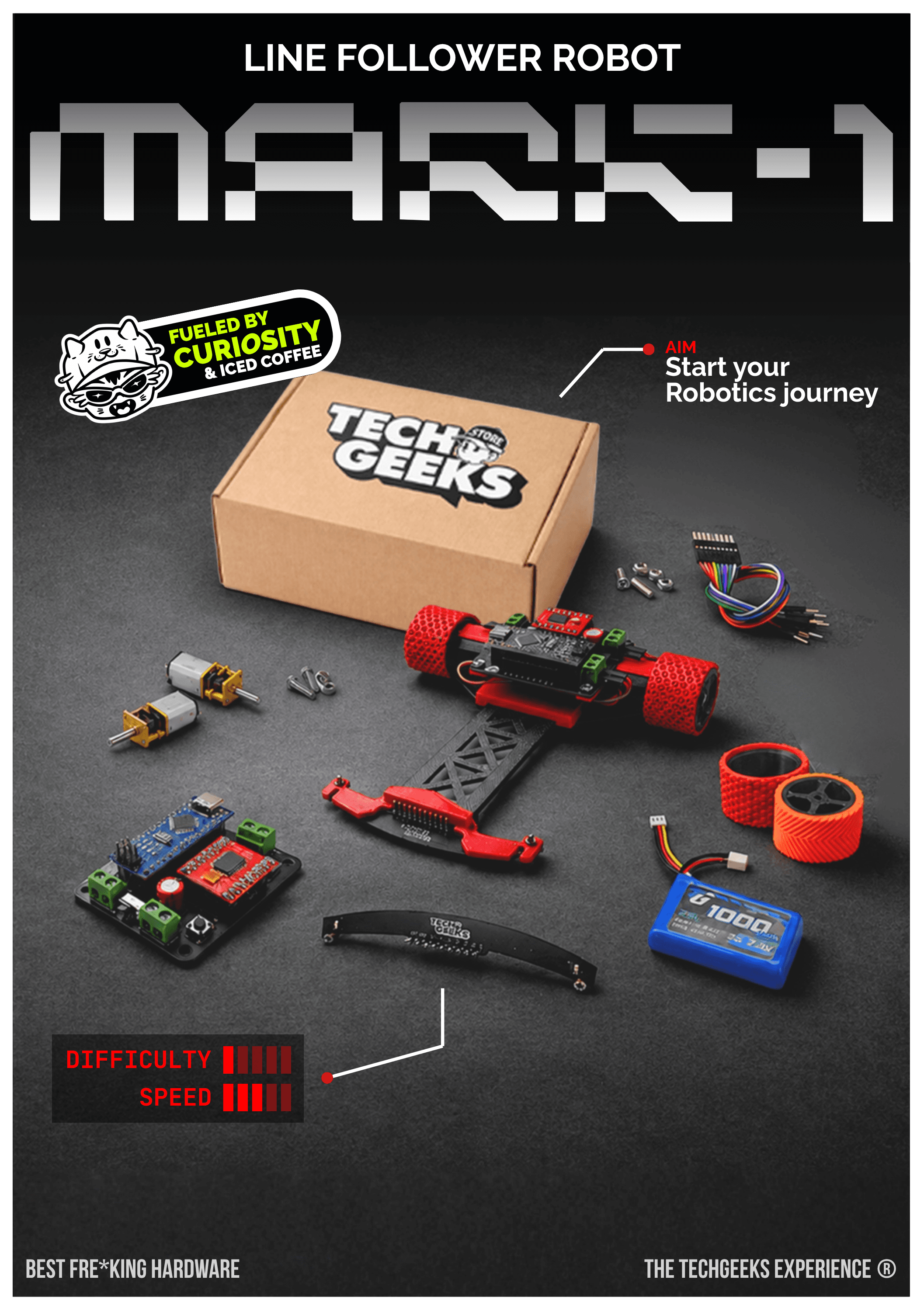
What it is: Mark 1 is Techgeeks' entry point into competitive line following: an Arduino Nano-driven bot built around the ARC8, an 8-channel analog IR sensor array, paired with a TB6612FNG dual motor driver and two 600 RPM N20 gear motors on a 3D printed chassis.
How you use it: You calibrate it by rotating it across the line to record min/max sensor values, then it runs a standard PID loop, reading eight sensor channels, calculating a weighted positional error, and correcting motor speed in real time through familiar Arduino functions like analogWrite(). Every part of that loop is written in approachable, readable code, and that's the point.
Why it matters: Most "beginner" LFR kits on the market hand you three fixed sensors and a basic comparator. You can't tune anything, so you can't learn anything. Mark 1 gives you a real 8-channel array and a real PID loop, so when you adjust kp and kd and watch the robot's behavior change, you're building an intuition for feedback control that transfers directly to every other robotics project you'll ever touch.
Who it's for: School or engineering students, robotics club newcomers, and anyone prepping for their first Techfest, e-Yantra, or college-level LFR event who wants a bot that rewards understanding why it works, not just that it works.
Mark 2: The Robot Built Around One Obsession (Speed)
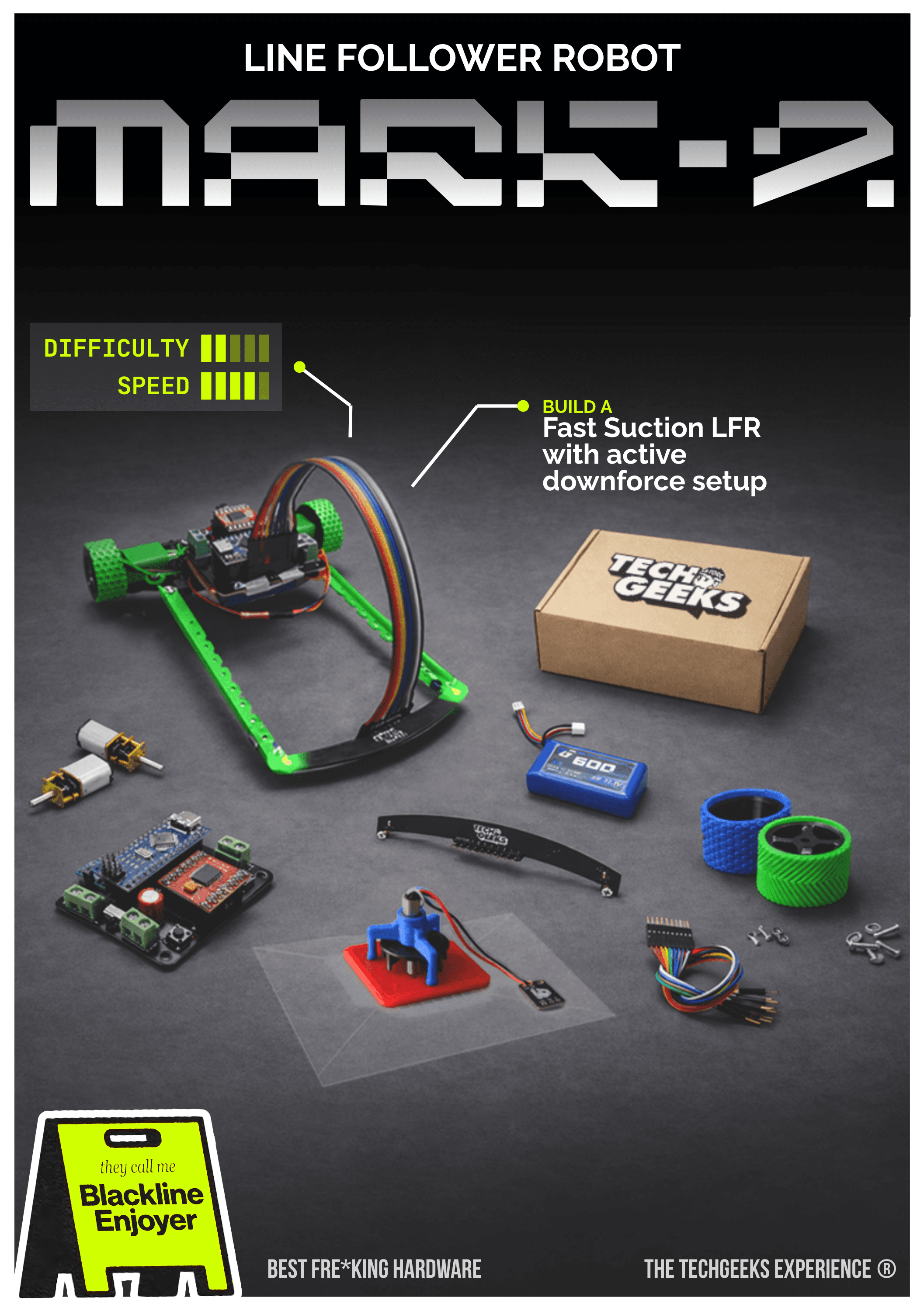
What it is: Mark 2 keeps the ARC8 sensor array but replaces almost everything else. It runs 2000 RPM N20 motors instead of 600 RPM, adds a 3S battery for more headroom, and bolts on the headline feature: an active suction system, an 8520 coreless motor spinning a 30mm centrifugal impeller that generates upward of 600 grams of continuous downforce.
How you use it: This is where things get genuinely technical. Mark 2 abandons the Arduino abstraction layer entirely and runs on bare-metal C, with direct AVR register access and manually configured PWM timers running at 31.25 kHz. That's quiet, efficient, and fast enough that standard digitalWrite() calls would actually slow the robot down. A PD controller computes error the same conceptual way Mark 1 does, but the execution path is stripped to the metal.
Why it matters: At high speed, a line follower's biggest enemy isn't the sensor. It's physics. Wheels lose grip mid-turn and the robot skates off the track no matter how good your code is. The suction system solves a mechanical problem with mechanical downforce, the same principle Formula 1 cars use to stay glued to tarmac through a corner, just shrunk down to a 150-gram footprint. Mark 2 is what happens when you've already mastered the fundamentals on something like Mark 1 and you're ready to chase lap times instead of concepts.
Who it's for: Builders who are done learning or up to speed with basic concepts and ready to compete: final-year project teams, speed-event veterans, and anyone who wants hands-on experience with register-level programming and real downforce aerodynamics.
Mark-X: The Robot Built to Out-See the Track
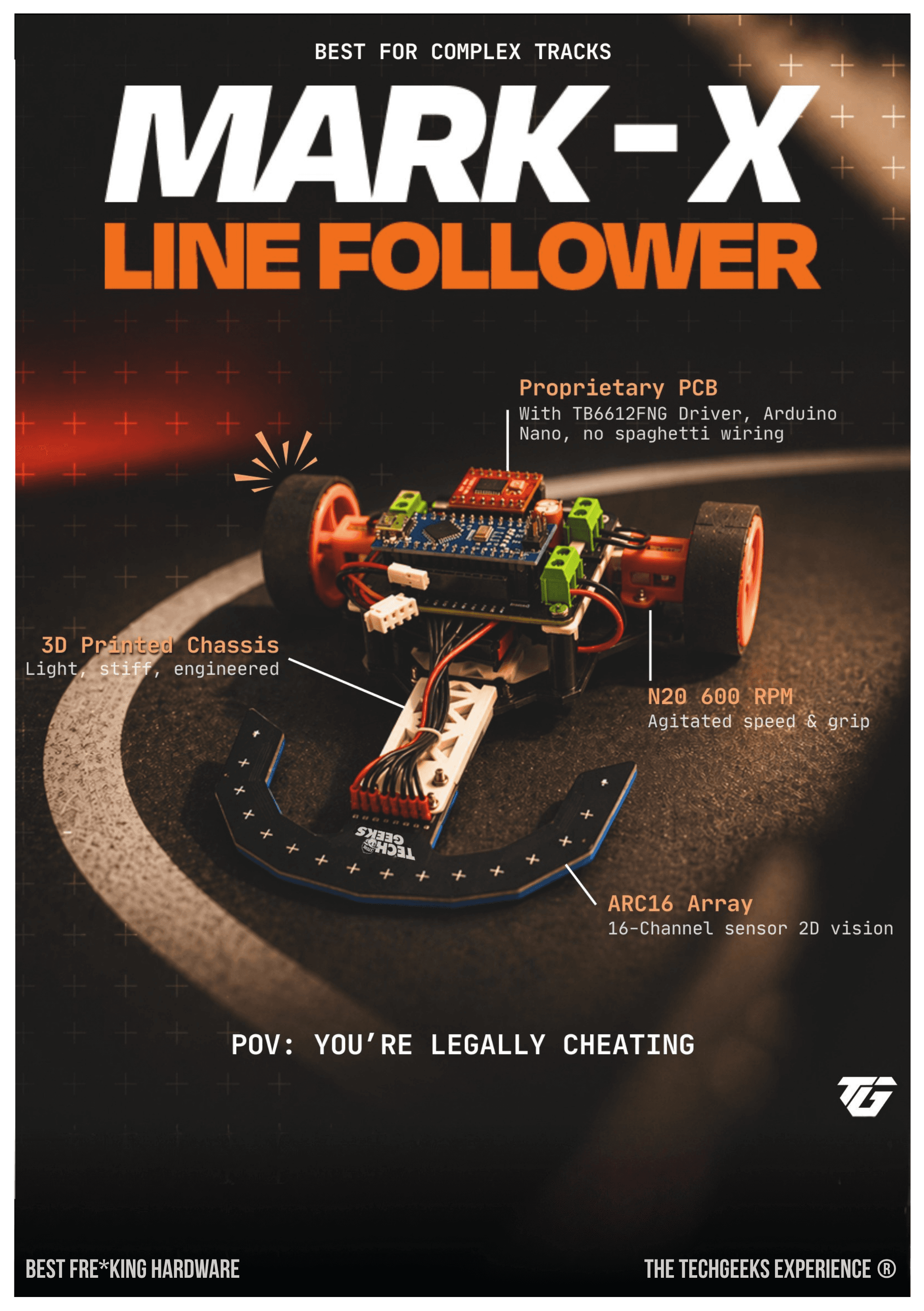
What it is: Mark-X takes the accessible Mark 1 hardware base (the proprietary controller board, TB6612FNG driver, Arduino Nano, 3D printed chassis, and 600 RPM N20 motors) and swaps the sensor entirely. Instead of the 8-channel ARC8, Mark-X runs the ARC16: a 16-channel array in a 16×4 multiplexed architecture, sampling at 10 kHz across a curved, two-dimensional field of view.
How you use it: The extra channels aren't just "more of the same." An 8-channel array tells your code where the line is. A 16-channel array, arranged with a 2D field of view, tells your code what shape the line is: it can distinguish a 90° turn from a T-junction, a + intersection from a line break, and a tight loop from an asymmetric branch. That means your firmware isn't just correcting position anymore. It's running pattern recognition and making routing decisions before the wheels even reach the fork in the track.
Why it matters: A faster motor doesn't help you if you don't know which direction to turn. Mark-X is Techgeeks' answer to tracks that stop being about speed and start being about geometry: mazes, multi-path arenas, and competition tracks designed specifically to punish robots that can only see a straight line in front of them.
Who it's for: Builders heading into maze-solving events, complex multi-junction competition tracks, or anyone exploring early AGV/AMR-style navigation logic where "which way do I go" matters more than "how fast can I get there."
A Different Way to Think About It: Camera Lenses, Not Race Cars
Everyone reaches for the car analogy when comparing robots: go-kart, sports car, race car. Let's skip that one, because it undersells what's actually different here. Try this instead: think of these three bots as three camera lenses.
Mark 1 is a 50mm prime lens. No zoom, no gimmicks. Just sharp, honest, dependable fundamentals. A prime lens forces you to understand composition because you can't fix bad framing by zooming; Mark 1 forces you to understand control loops because you can't fake your way past a bad PID tune.
Mark 2 is a telephoto sports lens. Built for one job: freezing a fast-moving subject without blur. Everything about it (the fast autofocus motor, the stabilization, the weight) exists to serve speed. It's not the lens you hand a beginner; it's the lens you reach for once you already know what you're shooting.
Mark-X is a wide-angle lens. It doesn't make anything move faster. It changes how much of the scene you can actually see at once, so you catch the junction, the branch, and the loop that a narrower lens would have cropped clean out of frame.
None of these lenses is "better." A wildlife photographer doesn't argue that telephoto beats wide-angle. They pack both, because the scene decides which one gets used. Your track decides which robot gets used, too.
Side-by-Side: Function Over Numbers
Mark 1 | Mark 2 | Mark-X | |
|---|---|---|---|
Core problem it solves | Learning feedback control | Beating physics at speed | Reading track geometry |
Sensor vision | ARC8 (8-channel, line position) | ARC8 (8-channel, line position) | ARC16 (16-channel, 2D shape detection) |
Firmware style | Arduino-level PID, readable | Bare-metal C, register-level PD | Arduino-level + pattern classification logic |
Motor speed | 1200 RPM N20 | 2000 RPM N20 | 600 RPM N20 |
Grip strategy | Standard traction wheels | Active suction (900g+ downforce) | Standard traction wheels |
Best track type | Standard straight/curved LFR tracks | High-speed competition circuits | Mazes, multi-junction, complex arenas |
Skill level | Beginner to intermediate | Intermediate to advanced | Intermediate, junction/maze-focused |
Its one superpower | Teaches why, not just how | Turns downforce physics into grip | Sees the fork before it gets there |
Conclusion
The mistake most first-time buyers make is comparing these three bots like they're the same product at different price points. They're not. Mark 1 builds your foundation, Mark 2 pushes your foundation to its physical limit, and Mark-X asks your foundation to get smarter, not just faster. The right one for you depends entirely on which problem your next track is actually testing.
So, before you add anything to cart, ask yourself one question: is your next track testing your fundamentals, your speed, or your ability to read what's coming?
Explore the full lineup: Mark 1 Line Follower · Mark 2 Advanced Suction LFR · ARC16 Sensor Array
Done reading? Return to the field notes index or keep exploring TechGeeks robotics parts.