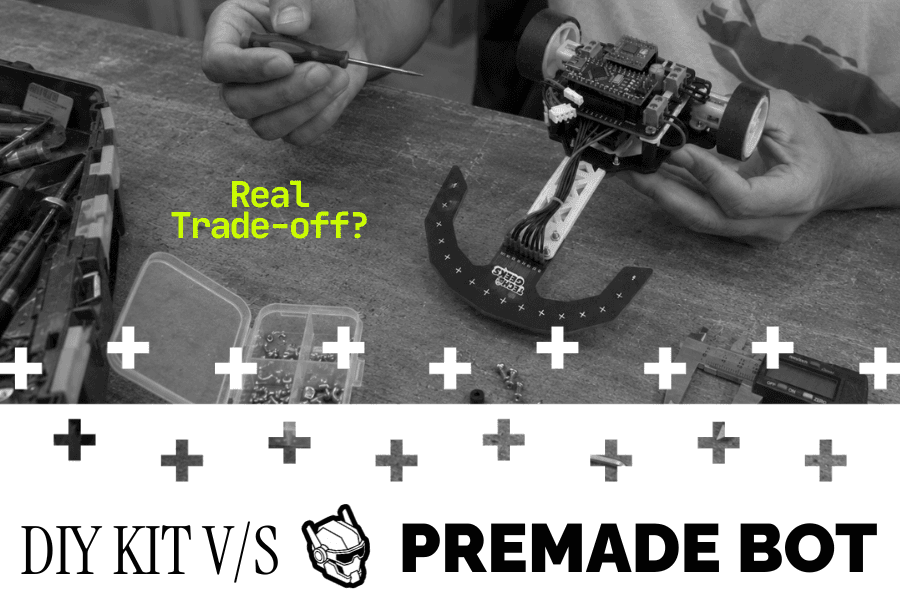
The site calls it "unassembled kit" versus "premade bot." What that choice really costs you is time, skill, and how well you know your own robot when it breaks. Decide by your deadline, not by which box looks easier.
BUYING GUIDE
Your event is two weeks out.
Most builders pick whichever option seems cheaper, or whichever one sounds less risky, and move on. Neither reason tells you whether you'll be soldering a cold joint at midnight, or standing at the track with a bot you've never opened, guessing why it's drifting.
The real choice is about time and skill, not price. Here's what each path actually costs you, and the one calibration step neither one skips.
Whichever way you go, race week has its own demands. Our firmware checklist before race day covers what has to be true on both a kit build and a premade one.
What a kit actually asks of you
An unassembled kit arrives as parts: the Arduino Nano, the sensor array, a motor driver, N20 motors, wheels, a 3D-printed chassis, a LiPo battery, and a wiring harness. You solder headers where they're not already fitted, wire motor leads to the driver terminals, seat the Nano, mount the sensor array at the front, then flash and calibrate the firmware yourself.
The joints that give first-time builders the most trouble are the ones carrying the most current: motor leads and battery terminals. Thicker wire needs more heat to flow properly, and a joint that looks fine but isn't often shows up later as a code problem that isn't one.
A kit trades your evening for full ownership of every wire in the bot.
What a premade bot skips, and what it can't skip
A premade bot ships assembled and ready to run: no soldering, no wiring harness, no chassis screws. That's the entire trade.
What it doesn't skip is calibration. The sensor array's calibration routine only means something once it has recorded your own track's black line and white surface, under your own lighting, because reflectance depends on both. A bot tuned on a bench somewhere else doesn't know your venue's overhead lighting or the exact surface your track uses.
So even a bot that arrives fully built still needs a few minutes rolled over both surfaces before its first serious run.
Premade buys back your evening. It doesn't buy back your calibration run.
The real cost of a wiring mistake under deadline
On a kit, a reversed motor lead reads as "the bot spins in place." A cold joint on a battery terminal reads as "the bot cuts out mid-run," and for the first hour of debugging it looks exactly like a firmware bug.
Two weeks out, that hour is expensive. It comes out of tuning time, not build time.
Premade removes that specific risk category before the bot ever reaches you. Assembly happens under controlled conditions, not on your desk the night before departure.
What you lose when you never open the box
The flip side matters just as much. A bot you never wired yourself is a black box the moment it misbehaves at the venue. If it drifts on one corner and not the other, you don't know if that's a loose header, a shifted sensor mount, or uneven wheel wear, because you've never had the case open.
Builders who assemble their own kit carry a working map of every connector in their head. That map is what lets you fix a problem in the ten minutes between runs instead of packing up early.
The kit's real product isn't the robot. It's the map in your head of how the robot works.
Decide by your calendar, not your cart
If you have two or more weeks and this is your first build, take the kit. The debugging happens now, away from competition pressure, and it's the same skill you'll lean on at the venue no matter what breaks next.
If you have under a week, or you've already built and tuned one bot before, take premade. Assembly risk is exactly the risk you can't afford to carry into race week.
If you're adding a second bot for a teammate on a team that already has a working build, premade lets them start on code and tuning immediately. That's where a second builder actually adds speed to the team.
Conclusion
Neither path skips the ten minutes on the actual track before race day. That's where a kit and a premade bot finally become the same robot. Everything before it is a question about your calendar, not your budget.
So before you add either to cart: are you short on time this week, or short on knowing your own bot when something goes wrong on race day?
If you've decided, the choice sits right on the Mark 1 product page: the same sensor array and firmware either way, just a different starting point for your two weeks.
Done reading? Return to the field notes index or keep exploring TechGeeks robotics parts.